What is BESS?
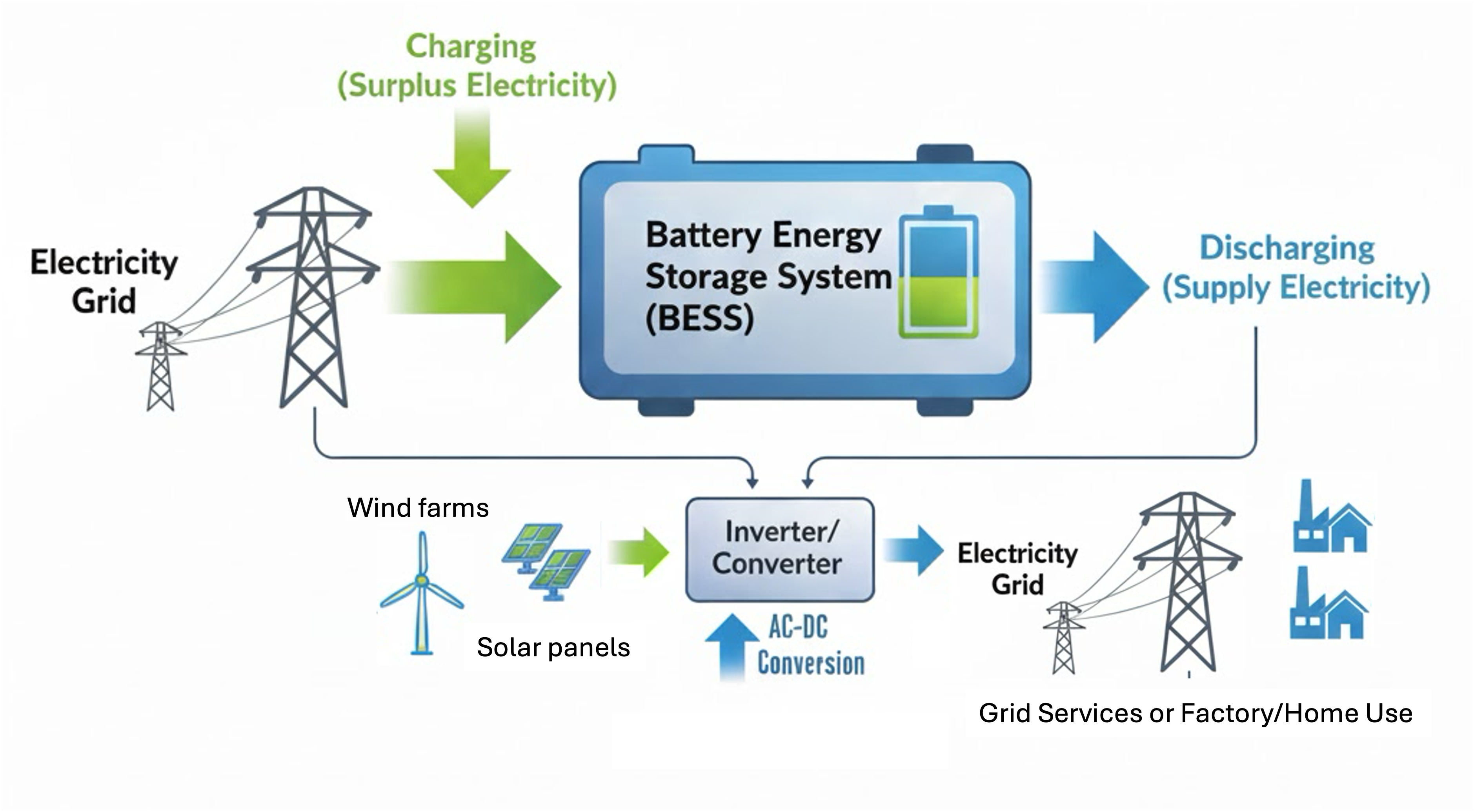
BESS stands for Battery Energy Storage System. It is a technology that stores electrical energy in batteries and makes it available when it is needed most. BESS installations can vary widely in size and design, ranging from small household systems to large, industrial-scale facilities that support the power grid.
At SolRix, we focus on large-scale BESS solutions directly connected to the electricity distribution network and operated in coordination with the transmission system operator. This allows stored energy to be used where it has the greatest system-wide impact.
The primary role of a BESS is to balance electricity supply and demand. It stores energy during periods of surplus generation and releases it when demand is higher or when grid stability support is required, helping to maintain reliable and stable operation of the power system.
How can BESS be used?
Market Arbitrage: Using Price Differences Efficiently
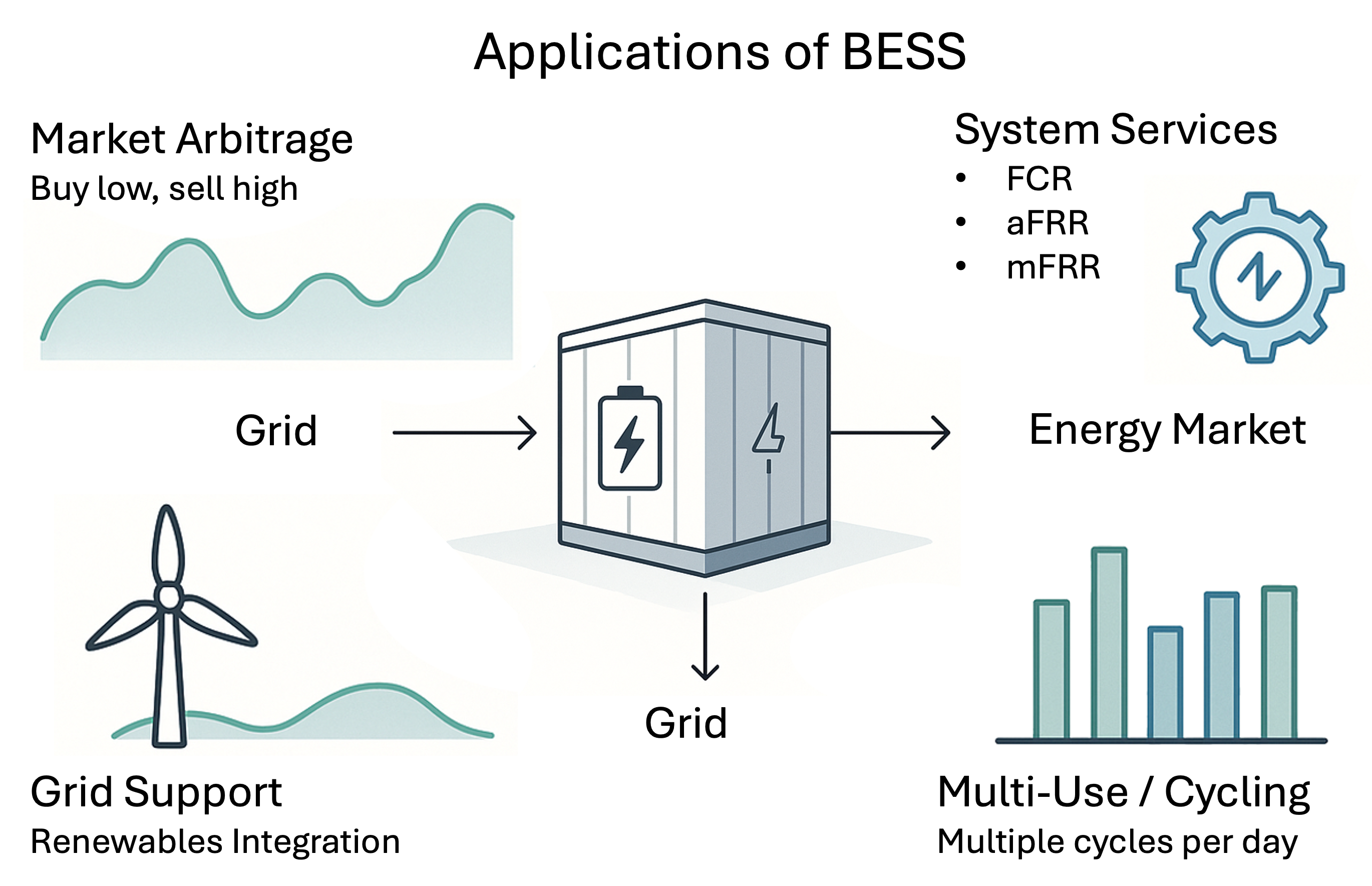
One of the key applications of a large-scale BESS is market arbitrage — charging the system when electricity prices are low and discharging when prices are high.
Electricity prices fluctuate throughout the day depending on demand, renewable generation, and system conditions. During periods of low prices, often caused by high wind or solar output, a BESS can store energy at low cost. When prices rise, the stored energy is sold back to the grid.
Example:
On a windy night, electricity prices drop due to excess wind generation. A BESS charges during these hours. The following morning, as demand increases, prices rise and the BESS discharges energy back to the grid. The price difference represents the value created through arbitrage.
Beyond financial value, arbitrage helps stabilise prices, reduces strain on generation assets, and improves overall grid efficiency.
System Services: Supporting Grid Stability
In addition to energy trading, a BESS can provide system services to the transmission grid. In this case, remuneration is based on capacity availability and rapid response capability rather than delivered energy.
BESS installations can participate in multiple reserve markets simultaneously, including FCR, aFRR, and mFRR. These services are critical for maintaining frequency stability and balancing the grid in real time. In Latvia, these markets have been open to BESS participation since early 2025.
Although revenues from system services are less predictable, they offer significant opportunities. Control can be fully automated via energy management systems or supervised by operators, making BESS a fast, flexible, and highly valuable grid asset.
Why BESS Matters in Modern Power Systems
As power systems increasingly rely on renewable and variable energy sources, flexibility becomes essential. Battery Energy Storage Systems bridge the gap between production and consumption, enabling efficient energy trading, fast system services, and improved grid stability. As a result, BESS is a core infrastructure component of modern, low-carbon electricity systems.